
Nitriva Clean · First market
Cold plasma-activated water. Designed around real hygiene challenges.
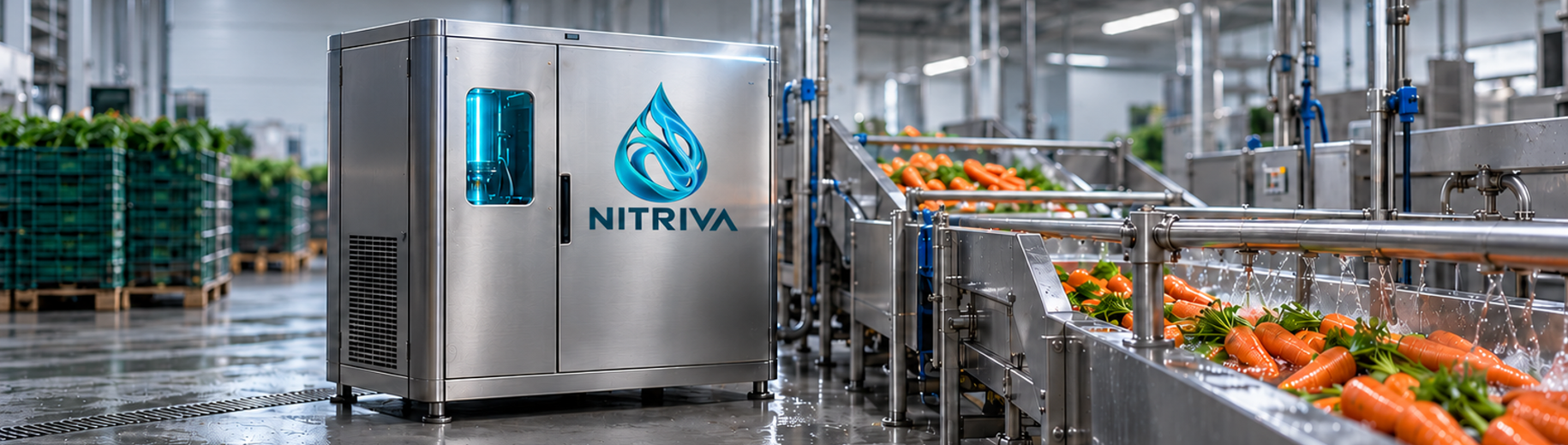
Nitriva Clean explores how water activated by cold plasma can support cleaning and sanitation processes — produced on site from electricity, air and water.
The concept
Reactive chemistry, produced where hygiene happens.
A controlled cold plasma process creates reactive species from air. Brought into contact with water, these species change its chemical properties. We are investigating whether those properties can contribute to effective sanitation in demanding environments.
Because the water is produced on demand, the approach may reduce the need to transport and store some conventional chemicals. Whether that holds for a given site is something we assess, not assume.
Intended applications
Where we are looking first.
Food processing
Production environments where hygiene, traceability and uptime matter.
Surfaces and equipment
Sanitation of contact and non-contact surfaces, subject to validation.
Existing workflows
Integration alongside established hygiene procedures, not in place of them.
Validation
What we need to validate
- Efficacy
- Performance against relevant organisms and soils under realistic conditions.
- Contact time
- How long treated surfaces need exposure to reach the intended effect.
- Water quality
- How input water properties influence the resulting chemistry.
- Storage stability
- How activity changes over time between production and use.
- Material compatibility
- Effects on stainless steel, polymers, seals and other equipment materials.
- Operating conditions
- Temperature, flow, dosing and integration with existing routines.
Nitriva Clean has no approved disinfection claims or food-contact authorisation. Any use in regulated environments will follow the applicable regulatory pathway.
Pilot approach
Start with one defined challenge.
A pilot begins with a specific hygiene task, agreed success criteria and measurement methods. We then test at lab scale, integrate a pilot unit on site and compare results against your current procedure.